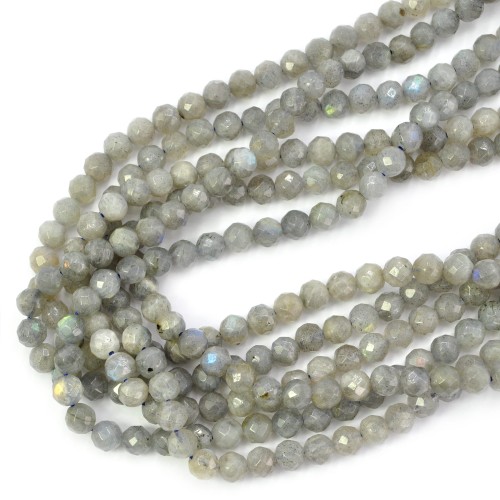
LABRADORITE - THE STONE OF LIGHT, MYSTERY AND UNIQUE PLAY OF COLORS
Labradorite is an exceptionally striking ornamental stone, primarily known for its characteristic optical phenomenon called labradorescence. At first glance, it may appear gray, graphite, or greenish, but when turned in the light, it reveals flashes of blue, green, gold, orange, and sometimes even violet. It is this "hidden rainbow" that has fascinated jewelers, collectors, and enthusiasts of natural minerals for years.
HISTORY OF LABRADORITE USAGE THROUGH THE AGES
Labradorite was named after the Labrador Peninsula in Canada, where it was described as a mineral in the 18th century. Its original known locality is in the Paul Island area, near Nain, off the coast of Labrador.
Although the name "labradorite" itself is relatively new, stones with similar iridescence have long attracted interest due to their unusual play of light. In the folk traditions of northern Canadian regions, labradorite was associated with the aurora borealis — according to one story, its light was trapped in the stone, which is why the mineral shimmers with blue and green reflections.
In the 19th and 20th centuries, labradorite began to gain popularity as a decorative and jewelry stone. It was used in cabochons, brooches, pendants, rings, sculptures, and ornamental objects. Specimens with strong, multicolored luster became particularly prized. Today, labradorite is one of the most recognizable stones with an optical effect and is readily found in both artistic jewelry and interior decorations.
ORIGIN OF LABRADORITE
Labradorite belongs to the feldspar group, specifically to the plagioclase series. It occurs mainly in igneous rocks such as basalt, gabbro, or anorthosite. Important sources of labradorite are found in Canada, Finland, and Madagascar. It is also found in Norway, Australia, the United States, and other locations around the world.
TRADITION AND SYMBOLISM
In stone symbolism, labradorite is often considered a stone of intuition, protection, transformation, and inner strength. Its changeable luster makes it associated with mystery, transition, uncovering what is hidden, and light appearing in darkness.
In esoteric tradition, it is sometimes called the stone of creative, sensitive, and searching individuals. It is attributed with supporting imagination, courage, and concentration.
It is worth remembering, however, that these are symbolic and cultural meanings, not scientifically proven healing properties.
AESTHETICS OF LABRADORITE
Labradorite has a very distinctive appearance. Its base is most often gray, graphite, greenish, or brownish, but at the right angle, intense light reflections appear. The most prized stones have a clear, broad flash in shades of blue, green, gold, or a multicolored rainbow.
Thanks to its depth and non-obviousness, labradorite fits perfectly into elegant, boho, artistic, ethnic, and minimalist aesthetics. It looks both raw and luxurious — which is why it works well in subtle jewelry as well as in expressive, large forms.
MINERAL PROPERTIES
Mineralogically, labradorite is a feldspar from the plagioclase group. Its hardness is approximately 6–6.5 on the Mohs scale, which means it is quite durable but more susceptible to scratches than quartz. It has a vitreous, sometimes pearly luster and can be translucent or opaque. The most important feature of labradorite is labradorescence — an optical effect created by the reflection and scattering of light within very thin, internal layers of the mineral. This is why the color "appears" only when the stone is positioned correctly relative to the light.
MEANING OF LABRADORITE
Labradorite symbolizes change, protection, intuition and discovery of inner potential. It is often chosen by people who like stones with a deeper, more mysterious character. It can be treated as a symbol of courage in going through new stages of life, creativity, and trust in one's own intuition.
As a gift, labradorite is well suited for creative, independent individuals who appreciate unusual accessories and natural materials. Its shimmering luster makes each piece look unique.
WHAT TO KNOW BEFORE PURCHASING?
When purchasing labradorite, it is important to pay attention primarily to the quality of the flash. A good stone should have a clear labradorescence visible at the right angle. The stronger, more extensive, and multicolored the effect, the more attractive the specimen usually is.
It is also worth viewing the stone from different sides, as labradorite does not shimmer equally from every angle. Natural cracks, veins, and irregularities are common but should not weaken the stone's structure, especially if it is to be worn in jewelry.
Labradorite is best cleaned with a soft cloth and lukewarm water. It should not be soaked for too long or exposed to strong detergents, chemical agents, or ultrasonic cleaners. Due to the cleavage of feldspars, it should be protected from impacts, falls, and stored separately to prevent it from rubbing against harder stones.
WHAT DOES LABRADORITE GO WITH?
Labradorite pairs perfectly with silver, oxidized silver, steel, gold, brass, and darker jewelry settings. It beautifully complements moonstone, onyx, hematite, garnet, amethyst, turquoise, and rock crystal.
In styling, it looks great with black, graphite, navy blue, bottle green, white, beige, and natural fabrics. It can be a subtle accent in minimalist jewelry or a strong, artistic element in a large ring, pendant, or bracelet. In interiors, labradorite suits natural, elegant, and somewhat mysterious arrangements. It looks good on wood, stone, dark metal, among candles, plants, and earth-toned accessories.
SUMMARY
Labradorite is a stone that captivates with its unobvious beauty. Seemingly calm and dark, under the influence of light it reveals intense flashes of color. It combines natural rawness, elegance, and rich symbolism. It will work well in both jewelry and decorations, especially for those who appreciate stones with character. It is a mineral full of depth — ideal for those who value mystery, changeability, and a unique light effect.